2026-04-24 Physics-based simulation of electrochemical impedance spectroscopy of complex electrode microstructures
Time:2026-04-24(五) 15:20 pm
Topic:Physics-based simulation of electrochemical impedance spectroscopy of complex electrode microstructures
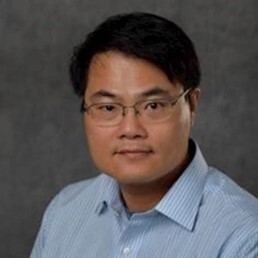
Speaker:游輝嘉 教授
Organization:美國密西根州立大學 計算數學科學與工程學系
Venue:93406
Host:林彥丞 教授
Abstract:
Electrochemical impedance spectroscopy (EIS) is a non-destructive characterization technique widely used in the electrochemical research field. It can measure many macroscopic properties such as internal resistance, capacitance, and diffusivity by fitting the obtained impedance with equivalent circuits. Each of the acquired quantities reflects an electrochemical mechanism, e.g., charge-transfer reaction, double layer formation, and mass transport, taking place in the electrode. However, the obtained quantity is a total value for the whole electrode. The underlying connections between the macroscopic properties, intrinsic material parameters, and electrode microstructures are not well understood. This talk introduces a modeling framework to simulate EIS processes with given electrode microstructures and intrinsic material parameters. With this simulation tool, we provide a digital bridge between battery electrode material properties, electrode microstructures, and their corresponding EIS impedance.
Education and Experience:
Hui-Chia Yu is an alumnus of National Tsing Hua University (PME Class of ’97). He then earned a master’s degree in Mechanical Engineering and a doctoral degree in Materials Science and Engineering from the University of Michigan, USA, in 2009. In 2017, he joined the faculty at Michigan State University, where he holds a joint appointment in the Department of Computational Mathematics, Science and Engineering and the Department of Chemical Engineering and Materials Science.
Dr. Yu’s expertise lies in simulating moving boundary phenomena in materials science—such as phase transformations, crack propagation, and two-phase flow—using phase-field and level-set methods. His research also focuses on algorithm development for large-scale microstructure simulations, applying these methods to study a wide range of materials processes, including electrochemical reactions in porous electrodes, solid and fluid mechanics, sintering, and diamond growth.