2025-12-05 Artificial myofibrils: the hierarchical and anisotropic assembly of monodisperse nanosheets

時間:2025-12-05(五) 15:20 pm
講題:Artificial myofibrils: the hierarchical and anisotropic assembly of monodisperse nanosheets
講者:Dr. Nobuyoshi Miyamoto
服務單位:Department of Life, Environment, and Applied Chemistry, Fukuoka Institute of Technology, Fukuoka, Japan
地點:93456
主持人:姚少凌 老師
摘要 :
Living organisms possess superior functions such as energy conversion, actuation and sensing as well as basic materials properties like toughness, structural color, and self-healing. To mimic natural systems, precision synthesis of nano-building units and assembling them into hierarchical, anisotropic, polar, and soft architectures is a key; however, fabrication of very sophisticated structures like natural systems is still a big challenge. We have been focusing on inorganic nanosheets as excellent nano-building units because they spontaneously form anisotropic, hierarchical, and soft structures in regulated manners and they possess many functions inherent to inorganic materials.[1]-[3] Recently, we succeeded in fabricating unique columnar nanofibers (ColNFs) by assembling monodisperse nanosheets (mNS) as a primary nano-building unit [4]. The ColNFs were further assembled into nanofiber bundles (ColBuns) and macroscopic fiber like a myofibril and a muscle by tuning the solution condition and using electric field. This artificial muscle was reversibly and repeatedly actuated by sweeping an electric field frequency. The ColNFs can also be applicable as excellent nanofillers for polymer gels and resins, giving extreme toughness to the materials while keeping good degradability in environments after use and recyclability.
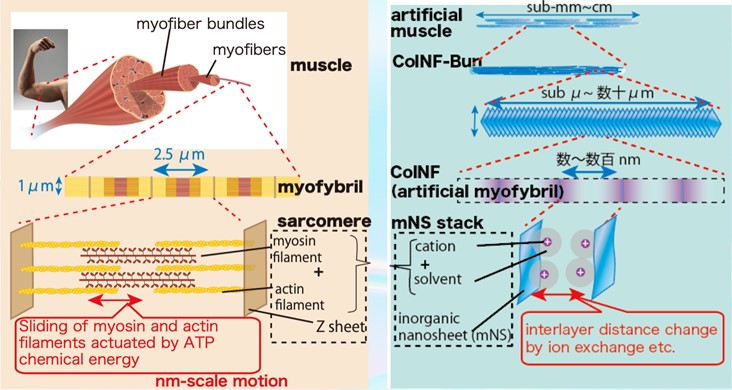
Fig. 1 Hierarchical, anisotropic, and soft strucutre of animal muscle and artificial muscle assembled from from monodisperse inorganic nanosheets (mNS).
學經歷 :
Dr. Miyamoto obtained his Ph. D (Engineering) from Waseda University, Japan, in 2004, supervised by Professor Kazuyuki Kuroda in the field of inorganic materials chemistry. He worked as a researcher at Tokyo University of Agriculture and Technology (2001-2003) and initiated the research of inorganic nanosheet liquid crystals working with Professor Teruyuki Nakato. He then moved to Japan Atomic Energy Agency (2004-2007) and engaged in in-situ structural analyses of soft materials by small angle neutron/X-ray scattering in the research team directed by Professor Takeji Hashimoto. In 2007, he moved to Fukuoka Institute of Technology, Japan, and is currently an Associate Professor of the institute. He was managing the project research (2015-2019) as the Research Director of Materials and Energy Device Research Center of Fukuoka Institute of Technology (FIT-ME) funded by the Strategic Research Foundation Grant-Aided Project for Private University from Japanese Ministry of Education, Culture, Sports, Science and Technology’s (MEXT), Japan. In 2017-2018, he was working at Laboratoire de Physique des Solides, Univesité Paris-Salcay, France, as a visiting researcher. From 2024, he is an Affiliate Member of the International Institute for Sustainability with Knotted Chiral Meta Matter (SKCM2) of Hiroshima University funded by MEXT World Premier International Research Center Initiative (WPI). His research mainly focuses on the synthesis of advanced functional materials based on the inorganic nanosheets liquid crystals and nanosheet/polymer composites. The main research fields are inorganic chemistry, colloid chemistry, materials chemistry, and polymer chemistry.